The short answer
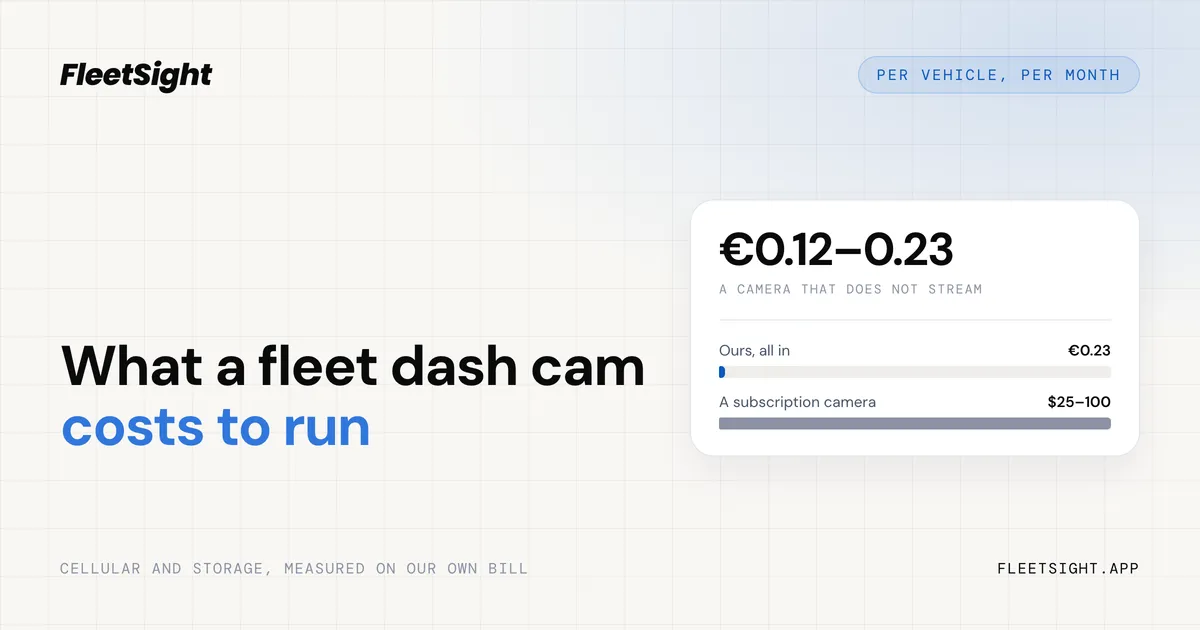
A camera that uploads events and clips on request, not continuous video, costs €0.12–0.23 a vehicle a month in cellular and under €0.004 in storage. One that streams everything spends about 6 GB a month — €9–18 in cellular alone, which is why a subscription camera is quoted at $25–100.
Everybody quotes the camera. Almost nobody quotes the twelve months after it, which is where a video product either keeps its margin or quietly loses it. This is our own bill, measured on our own architecture, published because an integrator pricing a contract deserves a number rather than a shrug.
The one decision that sets the bill
No video crosses the SIM on its own. Telemetry, events and one still frame per event go up continuously; a clip goes up when a human asks for it, for the window they asked for; live view runs for the minutes somebody is watching and is never stored. Everything else the camera recorded stays on its card, where storage costs nothing.
That is not a detail of implementation, it is the whole economic model. A gigabyte lifted over 4G costs €1.50–3. A gigabyte held for a month in European object storage costs about €0.0065. The ratio is 200–400 to one, so the architecture that uploads everything spends roughly 6 GB per vehicle per month — €9–18 in cellular alone, before anyone has watched anything. That is the reason a subscription camera is quoted at $25–100 a month.
What actually crosses the SIM
One vehicle, two channels, a position every ten seconds for eight driving hours a day, ten AI events a day:
| What goes up | When | Per month | Cellular |
|---|---|---|---|
| Telemetry, ~120 B a position with overhead | continuously | 12 MB | €0.02–0.04 |
| The event itself: type, confidence, position | immediately | 0.3 MB | ~€0 |
| One 80 KB frame per event | immediately | 24 MB | €0.04–0.07 |
| Ten clips pulled on request, sub-stream (4 MB each) | on a button | 40 MB | €0.06–0.12 |
| A normal month | ~76 MB | €0.12–0.23 | |
| The same ten clips, but pulled as main stream (20 MB) | on a button | 236 MB | €0.35–0.71 |
| One incident window off the card, 200 MB, once a quarter | on request | +67 MB | €0.10–0.20, or €0 on Wi-Fi |
Three things follow from that table, and none of them are about storage.
The most expensive line is the one a person triggers. The platform does not decide the bill; the operator pulling clips does. So the cost has to be visible to them at the moment they choose: which stream, how long a window, which channel.
Event frames are the heaviest thing that goes up by itself — twice the weight of all telemetry. Sending an 80 KB 720p preview instead of a 200 KB 1080p one saves more than any storage tuning ever will.
Sub-stream versus main stream is a five-fold difference on the same event. Pull the sub-stream by default; promote to main stream only for the clip that is going somewhere — an insurer, a lawyer, a disciplinary meeting.
What the storage side costs
Only what was lifted is stored: the frames and the clips someone asked for, kept 90 days.
| What is stored | Per vehicle | €/month |
|---|---|---|
| Event frames, 24 MB × 3 months | 72 MB | €0.0006 |
| Pulled clips, 40 MB × 3 months | 120 MB | €0.001 |
| Telemetry in Postgres, 137 B a row | 35 MB | €0.0015 |
| Total | ~0.23 GB | under €0.004 |
Two things worth noticing. First, the telemetry in the database costs about as much as all the video — 35 MB of positions on block storage (~€0.044/GB) outprices 120 MB of clips in object storage (€0.0065–0.0087/GB), because block storage is five to seven times dearer per gigabyte. Second, there is nothing to save on storage pricing. The gap between the most and least expensive provider is fractions of a cent per vehicle; pick a provider on jurisdiction, object lock and predictable egress instead.
The settings that actually move the number
These live on the camera, not on the server:
- Two streams recorded to the card. The sub-stream is what gets pulled first.
- H.265 where the model supports it — twice the hours on the card, half the weight of every retrieval. In our range EH26, EH21, EH24, EH03T-V2, EH80, MR01 and ES803 do; DR03 is listed as H.264 only.
- A key frame every second, so a twenty-second request cuts to twenty seconds rather than the nearest minute.
- 15 fps instead of 25. Enough to review an event, one and a half times more hours on the card.
- 720p preview frames, not 1080p. The single heaviest automatic line on the bill.
- Audio off unless the customer has a legal basis for recording cabin conversation.
- A trigger allow-list. Not every AI detection deserves a cloud event: smoking and no-seatbelt are answerable from the frame; a collision is not.
The card is the cold tier, and it is free
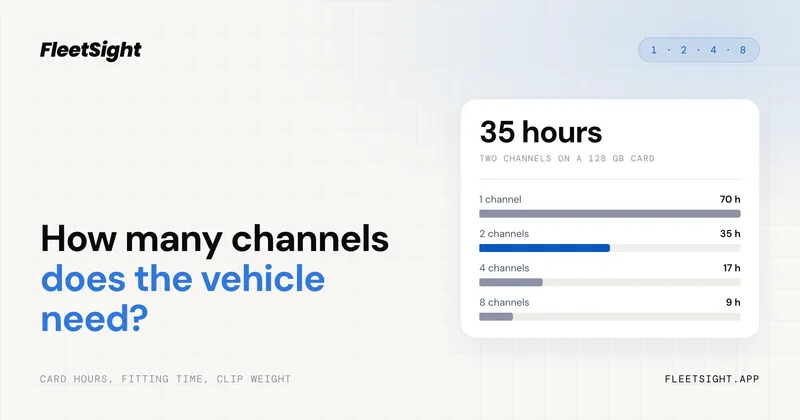
128 GB on board is roughly 35 hours of two channels at main stream, and about twice that for one channel. That is free storage and it should carry the archive. Bigger card, longer window on the day something goes wrong — for about €15 of memory rather than a recurring cloud line.
What this means when you price a contract
Hardware at €145–189 depending on volume, a platform that costs you nothing, and a running cost per vehicle of roughly:
- €0.12–0.23 a month in cellular on a disciplined month,
- under €0.004 a month in storage,
- plus whatever your own SIM plan’s floor is, which is usually the real constraint.
Against a subscription product at $25–100 per vehicle per month, the arithmetic over three years is not close, and we wrote it out against Samsara’s own list price. The honest caveat: those subscriptions buy a coaching programme, a support desk and a mature product. What they do not buy is a different cost of carrying bytes.