The short answer
Budget 45–90 minutes for a two-channel dash cam in a van and most of a day for a four- or eight-channel recorder on a truck and trailer. Seven steps, and the one that gets skipped is the last: a vehicle is not fitted until a frame from it has appeared on somebody's screen.
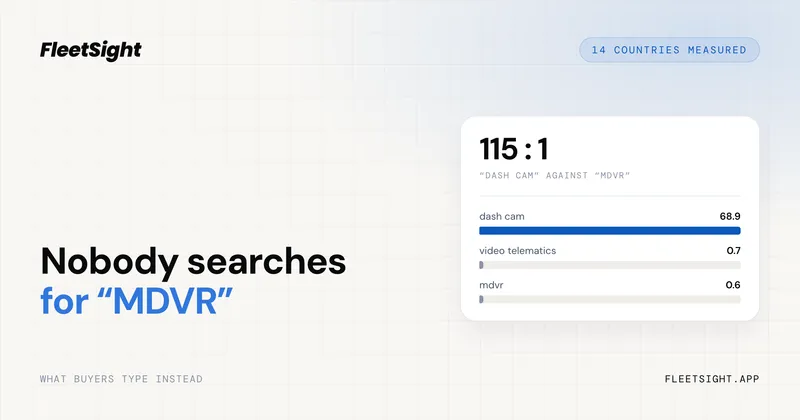
More people search for how to get a dash cam fitted than for every piece of industry jargon combined — in the UK, “dash cam installation” outweighs “video telematics” by roughly eighty to one, and “dash cam installation cost” has tripled in a year. That is a fleet trying to find somebody competent, and an installer trying to do the job properly. This post is for both. We do not fit cameras: we import them and run the platform, and fleet enquiries go to the integrator covering the region.
The fitting, in the order it happens
1. Power and the ignition line. Three wires: permanent, ignition sense, ground. Every model in our range runs 9–36 V, and DR03 and EH80 take 9–90 V, so a 24 V truck needs no converter. The ignition line is what lets the camera sleep instead of flattening the battery over a weekend, and it is the wire people skip when they are in a hurry.
2. The road camera. Behind the mirror, inside the wiper-swept area, lens level with the horizon. ADAS accuracy depends on this more than on the algorithm: mount it high and angled down and it will call lane departures all day until the driver mutes it and stops believing any of it.
3. The cabin camera. Driver-facing on the models that carry DMS, or an external DMS camera on the ones that do not. A 140° cabin lens covers a three-seat cab; a 60° DMS lens has to see the driver’s face and nothing else.
4. External channels. Trailer, tipper body, cargo doors, blind spot. Aviation connectors — 4-pin for the waterproof square camera, 5-pin for the DMS one — so a mis-plug is physically impossible. Route with the loom, leave a service loop at the hinge.
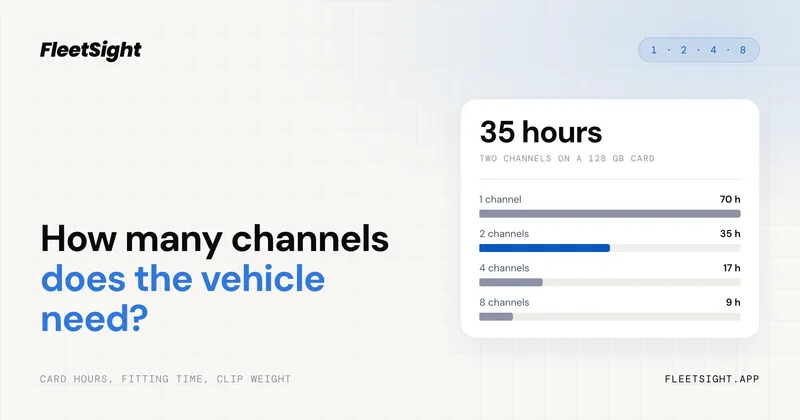
5. Card and SIM. One 32–512 GB card per slot, class 10 or better, formatted in the camera and never in a laptop. The card is the cheapest storage the fleet will ever own: everything not uploaded lives there, so a bigger card is a bigger window on a bad day.
6. ADAS calibration. Measure and enter the mounting height and the bonnet offset first; the V2 platform then self-calibrates in about two minutes of driving. Do it on the handover drive, not in the yard.
7. Commissioning. Register the ident, point the camera at the server, confirm the first position, force one event and watch the clip arrive. A vehicle is not fitted until a frame from it has appeared on somebody’s screen. This is the step that gets skipped, and it is the one that comes back a week later as a support ticket with the van three hundred kilometres away.
How long a vehicle takes
Budget 45–90 minutes for a two-channel dash cam in a van, and the better part of a day for a four- or eight-channel recorder with external cameras on a truck and trailer. Those are planning figures from the trade rather than measurements of our own kit — when we have timed a hundred fittings, we will publish what they actually took, including the ones that went wrong.
What moves the price
- Channel count. Every extra camera is a cable run, and cable runs are the job.
- Vehicle type. A panel van is trim clips; a tractor unit with a trailer harness is a different afternoon.
- Where the recorder lives. Under a seat with a ventilated bracket is fine; in a sealed box behind the bulkhead is an hour of fabrication.
- Whether the fleet is in one yard or spread out. Mobile fitting costs more per vehicle and is often still cheaper than the downtime of driving vehicles in.
- Calibration and handover. The temptation is to bill a fitting and skip the drive. Then the ADAS alerts are wrong and the whole system loses the fleet’s trust in a week.
Three questions worth settling before the van arrives
Does it have to be hardwired? For a fleet, yes. A cigarette-lighter camera is unplugged by the driver on exactly the day you need it, sees nothing while the vehicle is parked, and cannot sleep on an ignition line.
Will it work on 24 V? Yes — 9–36 V across the range, and 9–90 V on DR03 and EH80, so trucks, buses and most plant need no converter.
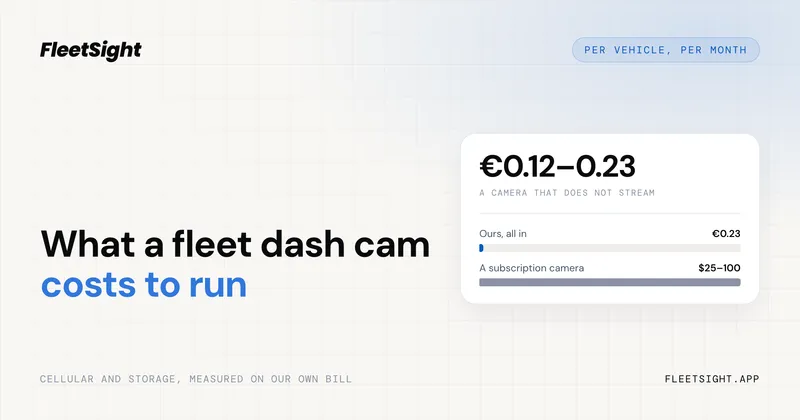
How much mobile data will the fleet pay for? Tens of megabytes a month: telemetry, events, one frame each, and video only when somebody asks for a clip. That is €0.12–0.23 of cellular a month, not the gigabytes a camera that streams everything spends.
What the platform needs on the day
The five things that turn a fitted camera into a vehicle on somebody’s screen: the device ident from the label (not the SIM number), the host and port for the gateway, the APN, a recording policy saying what uploads by itself and what waits to be asked for, and a camera-health check before the vehicle leaves — online, card present, lens clear.
The full version of this list, with the hardware notes per model, is on the installation page; the catalogue with the specifications is here.